
Kraków isn’t exactly a hidden gem to the rest of the world, but to most Americans like myself, I knew nothing about it. My knowledge of Polish cities began and ended with Warsaw (though geography was never my greatest strength). Daydreams of European cities typically involve Paris, Barcelona, or Florence, but to my surprise after visiting Kraków, all I want is to go back. I fell in love with a city that I didn’t know existed, and I left before we really got to know each other. Luckily, my girlfriend’s family is from Poland, so Kraków and I will be united once again, but when is anyone’s guess. In the meantime I encourage, no, I implore you to visit Kraków yourself, because who knows, maybe you’ll fall in love too.
It’s not every day that you find yourself flying to Europe to visit your girlfriend’s grandparents, but if that time comes, don’t fight it. I conceded and before long, I was in Frankfurt, Germany for a brief layover before our connecting flight into the Kraków John Paul II International Airport. Before we go any further, I just want to specify that pronouncing things in Polish is incredibly difficult and I am not nearly educated enough to attempt to teach, but the one thing I can correct is that Kraków is pronounced more like “Krah-koof.” For all other Polish words for the remainder of this article, you are on your own.
One thing I really appreciated about Kraków was that English is quite common there. Booking a hotel room or AirBNB, or just asking questions about the area in general wasn’t an intimidating experience. I was fortunate to be traveling with fluent Polish speakers and I gave my best effort to speak the language, but whenever I felt like giving up and resorting to my native tongue, locals were kind enough to make things easier.
Where To Stay
When booking a room, we had one goal in mind: be as close to the heart of the city as possible. AirBnBs are plentiful and offer an authentic experience, but there are also some unique and beautiful hotels if that is your preference. We went with an AirBnB just one block away from Kraków’s most iconic attraction, the Rynek Główny, a.k.a the Main Market Square. The side streets are beautiful and historic, but the second I turned a corner and stepped into the main square, I was awestruck.
The Main Market Square
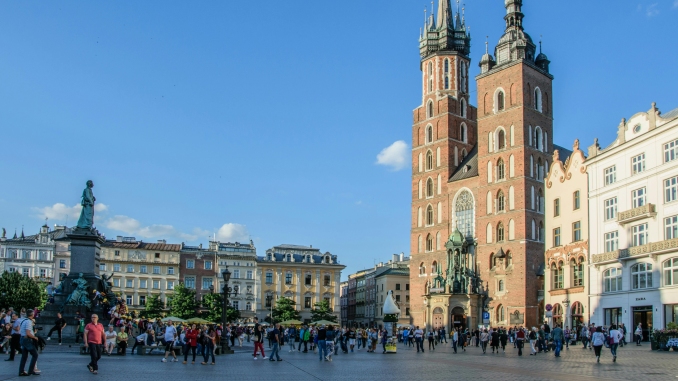
Established in 1257, the Main Market Square is Europe’s largest medieval square, a vast open space lined with tall townhouses of different colors, towering spires, and overall some of the most timeless and picturesque architecture I’ve ever seen. The square itself is 40,000 square meters (as the Europeans would say) which is 430 thousand square feet, or almost 10 acres, and I’m not sure if any of these units of measurement are helpful but the point is that it’s grandiose. I happened to visit in the middle of March and expected the weather to be cold, but instead we were greeted with early spring temperatures upwards of mid 60-degrees. Even more unexpectedly, the square was practically empty. In the summer months, peak tourism can mean 10-20 thousand people in the square throughout the day, whereas our trip felt as if we had it all to ourselves.
The first thing I noticed about the main square was one of Kraków’s most popular landmarks, the St. Mary’s Basilica: a Gothic Roman Catholic church with two mismatched towers. Every hour, high up in the towers, a window opens and a trumpeter emerges to play the Hejnał Mariacki (St. Mary’s Trumpet Call), a short melody that cuts off abruptly to honor the 13th-century guard who was killed mid-song during an invasion. Directly in the middle of the square is the Sukiennice (Cloth Hall), a large renaissance trading hall lined with vendors on the ground floor, and restaurants on the terraces above.
Alongside the Cloth Hall is the Town Hall Tower, which is the last remaining figure of Kraków’s old town hall, and the Eros Bendato, a large bronze sculpture of the dismembered head of Eros, the Greek god of love and desire. Encircling the area is Planty Park, a quiet greenbelt built on the ruins of the old city walls, in which few fragments still remain. It’s often said that the simple things in life can offer the greatest pleasures, and I believe that’s the perfect way to describe walking down the paths of Planty Park.
However, the beauty of Kraków isn’t just contained to this one part; the city consists of several distinct areas, each with its own character.
Key Areas of Kraków
Kraków has three main areas: the Old Town (home of the Main Market Square), Wawel Hill with its royal castle, and Kazimierz (the old Jewish quarter), each with its own blend of Gothic, Renaissance, and Baroque architecture.
Overlooking the Vistula river, Wawel Castle served as the home of Polish kings for centuries. Unfortunately, I didn’t have the time to take a tour inside of the historic castle, but I did get to walk through the main entrance’s portcullis, explore the open courtyards, and admire the ornate chapels, all offering a glimpse of what medieval royalty must have been like. This was the first real European castle I had ever been to, and it was more magnificent than I could have imagined. I felt all it was missing was a dragon, but to my surprise, there is one. Underneath the castle is a literal dragon’s den, with the entrance guarded by a large fire-breathing bronze statue known as the Wawel Dragon. It’s not as intimidating as it sounds, and the area is actually a popular stop for families, where kids watch in awe as the dragon spews its flames roughly every ten minutes or so.
South of the Old Town is Kazimierz, which is now one of Kraków’s trendier and vibrant areas. It was once the center of the Jewish community, but now amongst the historic synagogues, century old buildings, and cobblestone alleys, it has become the home to a variety of boutique cafes, vintage late-night bars, and candlelit restaurants. It reminded me of Brooklyn’s hip bar culture, but much older, and authentic. Every bar seemed like it was 200+ years old, and that’s because it probably was.
Exploring every aspect of Kraków is an absolute must, and I haven’t even scratched the surface of its rich history, so I highly suggest taking a golf-cart tour around the city. Many companies offer tours at different prices, but we just wandered around until we happened to bump into the tour guide of our dreams. His tour was affordable, he spoke English perfectly, which was a blessing for my girlfriend so she didn’t have to translate everything for me, and he quite literally knew everything there was to know. We started pointing to random buildings to test his knowledge, and he’d fire off historical facts that made the city feel even richer. At the end of the maybe two-hour long tour, he dropped us off at his favorite spot for a drink.
Cafes, Restaurant, & Bars
Cafes are everywhere in Kraków, and my go-to was a cappuccino with a traditional Polish breakfast platter consisting of fresh bread, ham and kielbasa, sliced gouda or farmer’s cheese, and a side of eggs with fresh vegetables. Kraków is easy to explore on foot so it’s important to start your day with enough fuel to keep you going. Since I was in the motherland of pierogi, there was nothing else more suitable for lunch, but dinner is where the meals started to literally get adventurous.
We dined at Pod Aniołami, a restaurant inside a 13th century building. Unlike most restaurants where you usually sit at ground level or above, this restaurant brought us two floors below into a literal cellar. A boutique dungeon if you will. Stones protruded from cracks in the walls, miniature angels perched at every corner, and we sat next to literal medial weapons. I loved everything about it and I wish more restaurants were in gothic chambers. But the best part may have been when we asked for the check. The bill seemed frightening at first but thankfully złoty, the Polish currency, trades at roughly four-to-one against the U.S. dollar, meaning divide the total by four and you have the real price. In the end, I was amazed at how affordable our meal was and serious thoughts about moving to Poland began to cross my mind.
We capped the night off bar hopping down in Kazimirez, and wound up in Singer, a dimly lit bar that felt more like a 1920s living room, but that’s far from a complaint. Singer is aptly named since most of the tables are repurposed sewing machine stations, so if you’re looking for a relaxing drink or need a quick hem, this place is the perfect spot.
Historical Sights
Poland is also home to some deeply significant historical sights that are important to experience firsthand. In the industrial zone of Kraków lies Schindler’s factory, which has since then become a museum that chronicles what life was like under Nazi occupation. More importantly, about an hour and a half from Kraków is the site of the infamous concentration camps, Auschwitz-Birkenau. I won’t go into much detail, but it was a profoundly moving and unforgettable experience that everyone should witness for themselves.
Leaving Kraków
Before I knew it, my time in Kraków was up, and it was time to head east towards the small towns where her grandparents patiently waited. The further you get from the main cities, the less English is spoken, so I spent most of the train ride there practicing and subsequently butchering simple Polish phrases.
First stop on the grandparent tour was the town of Leżajsk, a quaint town that offered a real glimpse of what growing up in Poland might be like. To my surprise, Leżajsk is the home to quite possibly the most beautiful church I have ever been to, the Bernadine Basilica and Monastery. Stepping inside was almost a surreal experience and I’m not even religious. The ornate Baroque interior is entirely covered with intricate paintings of saints and angels, the walls adorned with carved wooden and gilded figures, and the sounds of one of the world’s most historic pipe organs reverberates throughout. I was fortunate enough to get a full tour of the church and even got to briefly play the ancient pipe organ, which was maybe more terrifying than exciting since breaking something was a real possibility. To make the experience even more “heavenly,” the organ player treated us to a private concert, playing Charles-Marie Widor’s Symphony for Organ No. 5, which combined with the breathtaking interior, left me in complete awe.
After visiting the first pair of grandparents, we embarked on our third and final leg of the trip, to Rzeszów, a less touristy but still vibrant city of southeastern Poland. One thing I really loved about Kraków, Rzeszów, and even Leżajsk, was that despite their different sizes, each had its own town square. This small feature makes a huge difference, naturally bringing people together, and I truly wish every town had a square of its own.
Sadly, my trip to Poland had come to an end and it was time to head back home. Besides eating an uncomfortable amount of food to please the grandparents, my trip was an unforgettable experience, and I know I’ll be wandering the cobble stone streets of Kraków again in the future. An unexpected highlight was learning that both grandfathers we visited make nalewka, a homemade liqueur commonly made from quince fruit. They’ve perfected their recipes over decades and are always quick to refill your glass. I’ve even started making nalewka myself, so whenever I’m in need, I can always have a small taste of Poland.